AED 1,200sent by Aani at 10:14
The transfer that lives in a screenshot
You paid Al Hamra Supplies from your phone and sent them the screenshot. That screenshot is the only record, and it sits 200 messages up a chat.

Suppliers send invoices, staff send transfer screenshots, customers pay by e& money or Aani, all on your WhatsApp Business number. RetailLedger reads those chats and keeps a ledger of every dirham paid and received. It never sends a message, so nobody on the other side knows it's there.

Most of your payments already leave a trace in a chat. The trouble is that nobody copies them out until Sunday night, and by then half of them are buried.
You paid Al Hamra Supplies from your phone and sent them the screenshot. That screenshot is the only record, and it sits 200 messages up a chat.
"Chai ke 30 cash diye." Your staff member said it, you heard it, and it never reached the books. Multiply that by every small spend in a month.
A manager forwards a payment to the owner and the accountant. Whoever does the books counts it twice, and the month does not add up.
Press play to watch an ordinary morning at a restaurant turn into ledger entries. Nobody here typed anything into RetailLedger.
A message your business sends counts as money paid. One you receive counts as money received. A message from a staff phone counts as the shop's own spending.
People don't send payments in a neat format, so RetailLedger doesn't need one. It reads bank and wallet screenshots from Aani, bank transfers, e& money and Careem Pay, photos of paper receipts, PDF invoices, typed messages and voice notes.
It also reads the conversation around a payment. When someone writes "that was for rent" after a screenshot, the rent label goes on the earlier payment and no second entry gets created.
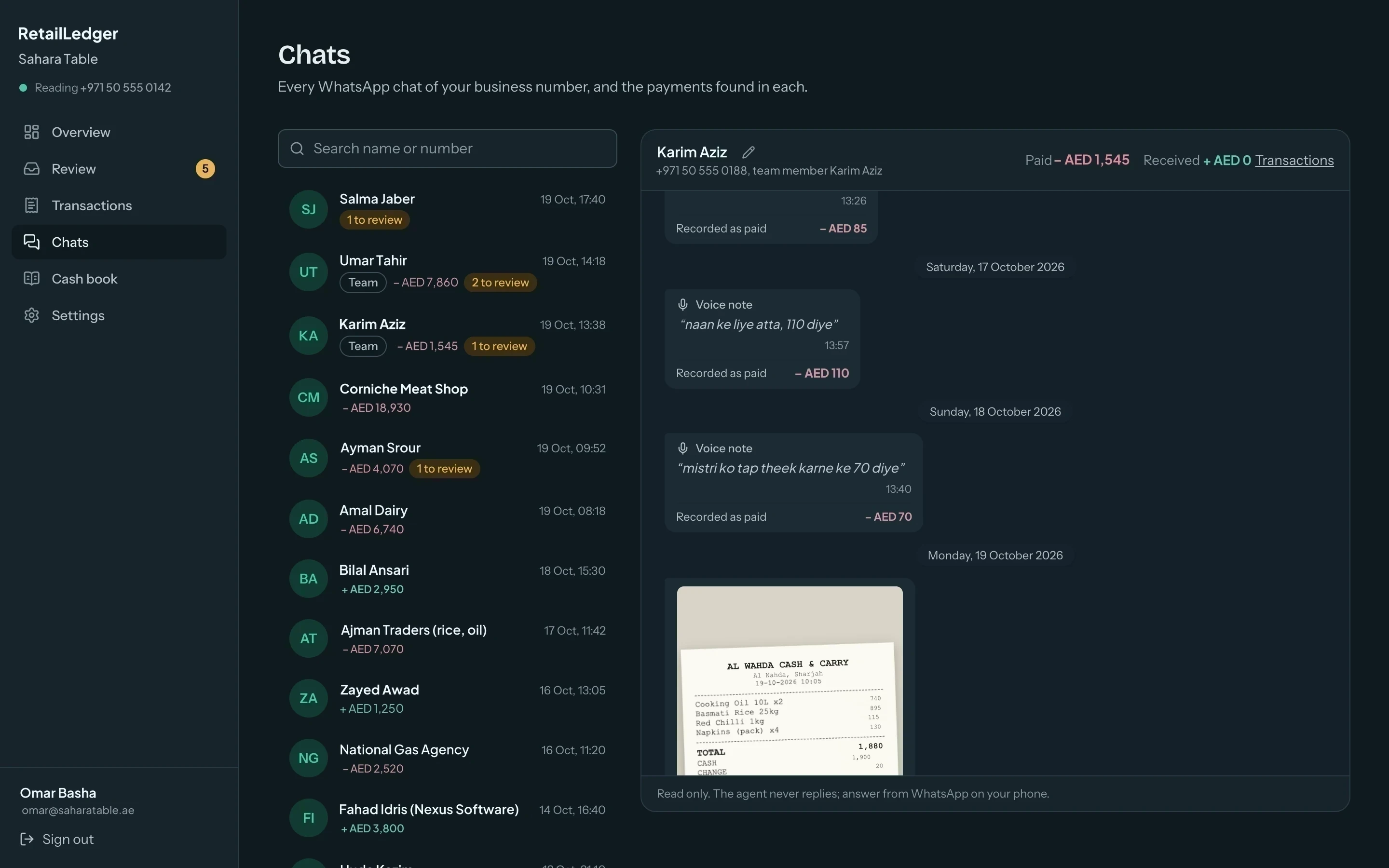
Clear payments go straight into the ledger. Unclear ones go to a review queue, where a manager sees the original screenshot or voice note next to what RetailLedger read from it.

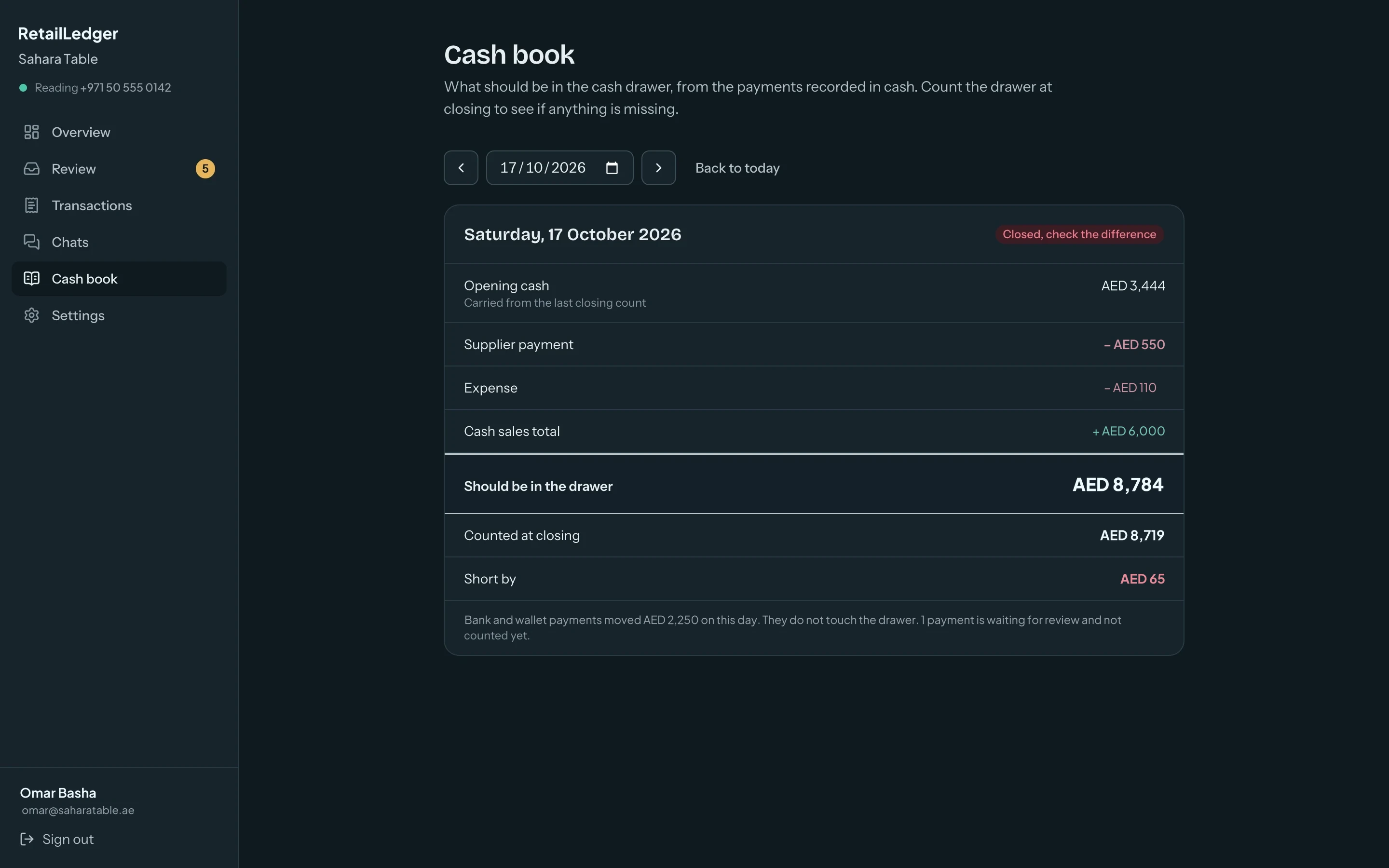
RetailLedger already knows the cash that came in and went out today. Enter the opening float and the counted cash at close, and it shows what should be in the drawer and the gap. Once you close the day, it's locked.
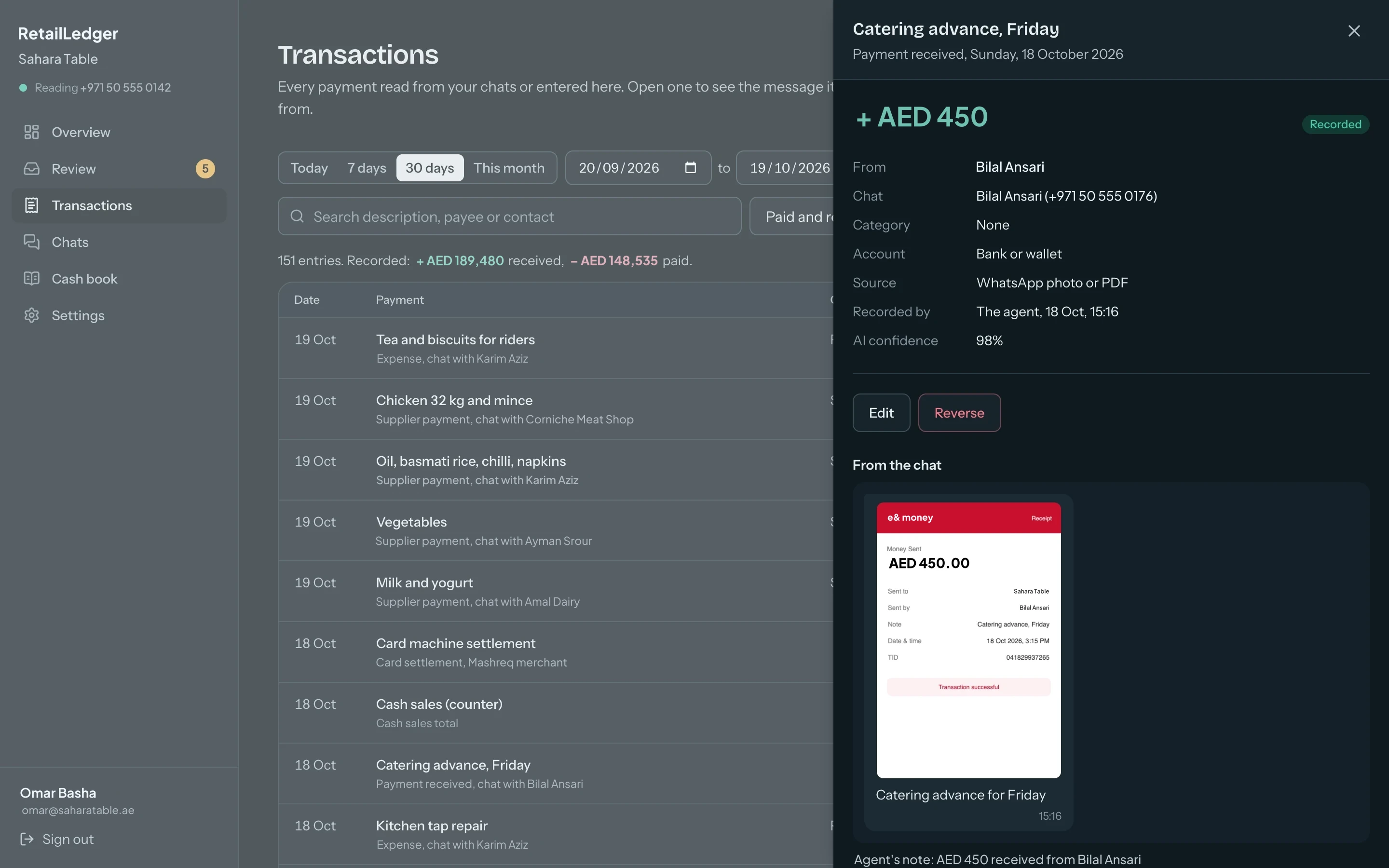
Filter by week, supplier, category or payment method, then download the lot for your accountant. Open any entry and you see the original message, plus a history of who changed what and when.
Owners hand RetailLedger their most sensitive chats, so we built it the way a careful bookkeeper works.
Supplier runs, catering deposits, staff spending petty cash on tea and gas cylinders, and a drawer to count every night.
Customers paying by wallet transfer, wholesalers sending invoices as photos, and staff ordering stock from their own phones.
Each branch keeps its own WhatsApp number. You get one view of money in and out across all of them, without calling each manager.
Categories and labels in English, Arabic and Urdu, in dirhams and your local time zone.
No. You and your staff keep using the WhatsApp Business app exactly as you do now. RetailLedger gets a copy of your one-to-one chats in the background.
Never. RetailLedger has no ability to send a WhatsApp message, and an automated check confirms that on every release. Your contacts won't see any change.
No. It sees one-to-one chats with saved and unsaved numbers. Group chats and phone calls stay out of it.
If it isn't confident, the payment goes to the review queue instead of the ledger. If a confirmed entry turns out wrong, a manager reverses it and the history shows both.
Yes. Filter any period and download it as a spreadsheet. Every line carries its category, payment method and a link back to the message it came from.
We connect your WhatsApp Business number with you, set up your categories and invite your team. Payments start appearing from the next message onwards.
Book a demo. We'll walk through a week of sample restaurant payments in RetailLedger, then map out how it would fit the way your business gets paid.